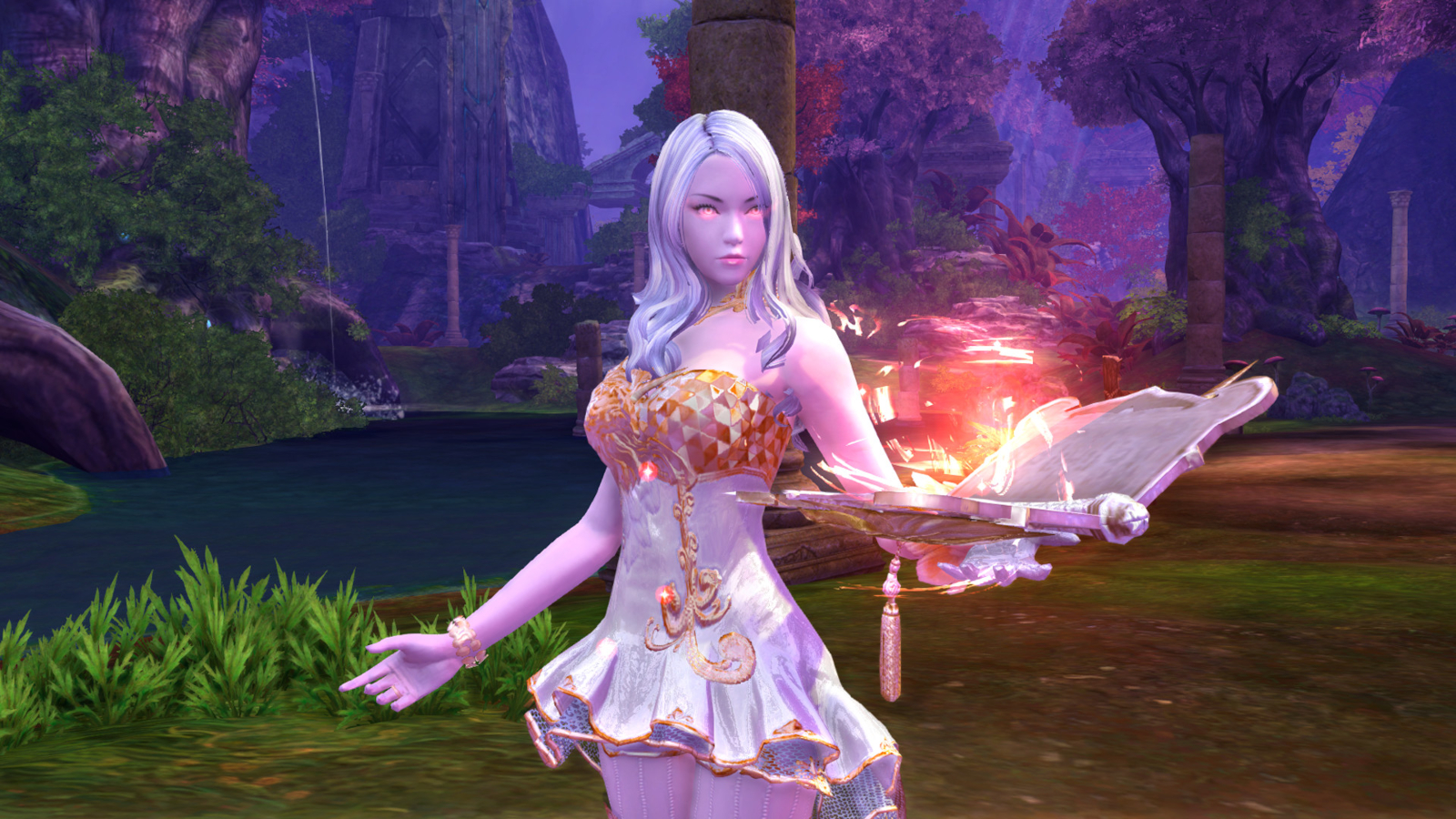

Yesterday I was browsing r/MMORPG on Reddit (as one does) and came across it by chance this interview In it, NCSoft America CEO Jeonghee Jin said that she believes there is still hope for MMOs as a genre. This is largely because she believes there is a cyclical pattern in the types of games that pique people’s interest.
It makes sense when you look at other industries. Clothing generally follows a 30-year cycle. That’s why they say that if you wait long enough, everything will come back into fashion. The same applies to music too. It may not be a 30-year cycle, but in the ’90s we had this swing revival. And it usually takes a decade or two before we all forget how much we hated having to wear those stupid glasses to watch 3D movies and having to go through the whole thing again. (I’m honestly not sure what’s worse: the little cardboard ones that would slip off your face, or the plastic ones that you know hundreds of other people have worn before you, and you just have to hope that the underpaid staff somehow cared enough to clean them up.)
The point is that things tend to move in cycles when it comes to trends and popularity. Why shouldn’t the same apply to games? I mean, the popularity of turn-based games seems to be on the rise again lately – thanks to some standouts.
Jin believes that this also applies to MMORPGs and that they are currently at the end of this circle – meaning that they will soon regain some kind of popularity. She points out that many gamers still spend time with the older MMORPG games that are “10 または 15 years old” and believes this is a sign that “there’s still room.” “There is a loyal audience that forms real communities, that makes games a part of their lives. That’s exactly the audience that MMORPGs appeal to.”
She’s not wrong. Although it’s pretty obvious that just creating a new MMORPG isn’t enough. Don’t get me wrong, long-time MMORPG fans will definitely give the new one a try. We’ve all done this before. How many MMOs have you looked closely at in the run-up to release and jumped into it on day one, only to return to your MMO of choice not long after and never really look back? または, at best, the new MMO becomes a minor distraction while you wait for your home to get a new update.
But we’ve all seen recent MMORPGs that either failed within a year or two of release or didn’t launch at all. The general consensus is often that the genre has already attracted its player base; that newer gamers who are used to things like MOBAs and other genres that may not require as much dedication or that are better designed for mobile devices and therefore easier to take with them, are not interested in playing traditional MMORPGs. Add to that the fact that the existing player base has games that they’re dedicated to, and it doesn’t exactly set the stage for a new entry to gain traction in the genre.
まだ, she seems to believe there is hope, pointing out that younger players’ investment in Roblox and Minecraft suggests that they “already understand what it means to belong to a gaming world and community,” which she says “bodes well for MMORPGs in the long run.” I’m not saying that these games don’t create some kind of community, but my personal impression is that they are a bit freer than a standard MMORPG. People can build communities around almost anything. That doesn’t necessarily mean you want to spend hours wading through complicated storylines. Heck, even a lot of MMORPG players don’t want that.
Roblox and Minecraft offer something else to players. Your experience in these… (I wouldn’t even exactly call Roblox a game) allows players to create their own experiences. The games don’t really have a pre-built world. And they don’t necessarily require players to be in an environment where they can interact with other people whether they want to or not. When I played Minecraft, I played with a maximum of five people… all friends. This isn’t the same as jumping into Eorzea and seeing a few dozen people you’ve never met standing around an Aetherite. There is no need to adhere to the etiquette of collecting items or targeting mobs that also target strangers. And then there’s the whole process of doing things like interviews to find a weekly raid group that’s the right fit.
付与された, it’s been ages since I’ve played Minecraft, and I’ve never played Roblox, but I don’t think these things are a main part of the games. I imagine that, just like traditional MMORPGs, there is an element of simply being in more public places to see and be seen.
しかし, I don’t think all of this necessarily makes these players good candidates for what we would call MMORPGs.
There is a broader meaning of MMO: “Massively Multiplayer Online.” This is used much more broadly. Although the validity of what constitutes something “massively multiplayer” could be debated. I think most traditional MMO players would argue that you need hundreds or thousands of players all existing on the same server with the ability to interact. Those who use the term more generally would argue that it is an MMO, if at all it is a multiplayer game and a lot of people play it. Both are technically correct, but only one has the right atmosphere.
加えて, even fans of traditional MMORPGs aren’t exactly jumping on board the new moves. Or at least don’t stay here. This is caused by a combination of things: games don’t really offer anything new, developers don’t listen to feedback (or listen too late), companies completely change what a game should be at the last minute (seriously, stop doing that), and remove the feature that had interested potential players in the first place.
And of course there is still the question of monetization. If you ask some gamers why they still participate in a game they started years ago despite newer games coming out, one of the reasons is probably the investment. If they’re playing a P2P game, they’ve probably invested quite a bit of money – even more so if that P2P game includes microtransactions with cool stuff. And of course there is also the waste of time. 例えば, it is a well-known fact that many Final Fantasy players
はい, はい, I know. World of Warcraft cases… しかし… you know. We are already invested. (And you’re still talking about another P2P game.
Free-to-play can be even trickier. There is always the argument that they can be a pay-to-win game. But since it’s F2P, there’s also the problem that players can easily switch allegiances. そしてもちろん, it’s about getting enough players to put money into your F2P MMO to keep it alive for everyone else there. MMORPGs inherently require a community, regardless of whether a player wants to interact with it directly or not.
These days, the games that are most successful in the F2P system seem to be the ones that monetize access to characters in some way. Be it through gachas or through the systems associated with team shooters and MOBAs. Some MMORPGs do this too, but it doesn’t work for the genre as a whole – not in the way that other genres do.
All of this means that Jin might be right. But it also feels a bit overly optimistic when companies don’t adapt their approach to MMORPGs. If nothing else, there are enough genres now that allow people to play with their friends that aren’t your standard MMORPG. People have options. We’re kind of buried in them.
もちろん, she should try to be as optimistic as possible. Your company specializes in MMORPGs. They’re even preparing to bring Aion 2 to the West and of course hope it does well. 個人的には, I’m a bit skeptical about the game’s success. But it would be nice to be wrong.